
Introduction
Healthcare professionals in Qatar operate in one of the most trust-dependent professional environments in the world. A patient choosing a specialist, a clinic evaluating a referring doctor, or a healthcare administrator selecting a medical supplier is making a decision where credibility, accessibility, and professional presentation all carry real weight.
The business card — the doctor’s introduction tool — needs to communicate that standard. A paper card with a phone number and a clinic name is not enough. It doesn’t carry the clinic’s booking page. It doesn’t link to the doctor’s credentials. It doesn’t show patient reviews. It doesn’t open a WhatsApp conversation for appointment queries. And critically, in a healthcare context — where cards may pass through many hands — a paper card raises hygiene considerations that an NFC tap does not.
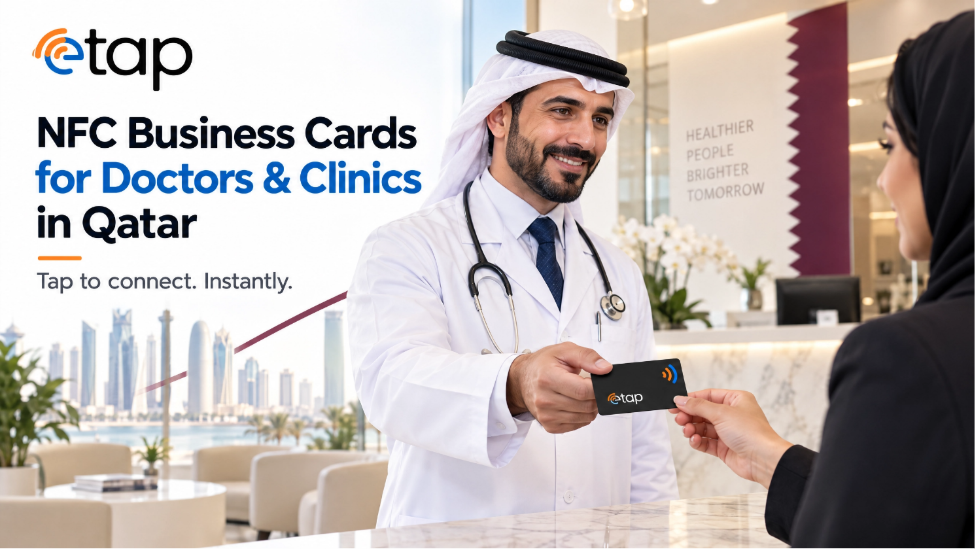
etap produces NFC business cards for healthcare professionals and clinic management across Qatar, enabling a complete, hygienic, and professional patient and colleague introduction in a single tap.
Why Healthcare Professionals in Qatar Need NFC Cards
Referring Doctor Introductions
Qatar’s specialist healthcare ecosystem depends heavily on referrals between GPs, specialists, and hospital departments. A specialist consultant who hands their NFC card to a GP during a CME event or a hospital department meeting gives the GP a complete, tappable profile — credentials, specialty, clinic address, booking link, and WhatsApp number — that immediately enables patient referrals without follow-up. The paper alternative — a card with a number to look up — creates friction that delays referrals and loses opportunities.
Patient-Facing Clinical Staff
Clinic reception staff, nurses, and practice managers who interact with patients directly benefit from NFC cards that patients can tap to receive: the clinic’s appointment booking link, the WhatsApp number for queries, the doctor’s profile page, the Google review link, and the clinic’s address and opening hours. Patients who leave a consultation with this information tapped into their phone are far more likely to book follow-up appointments and leave Google reviews than those handed a paper card.
Medical Industry Professionals
Pharmaceutical representatives, medical device sales professionals, and healthcare industry executives meeting clinical and administrative decision-makers in Qatar’s hospitals and clinics use NFC cards to share their complete professional profile — product pages, clinical data links, LinkedIn, and booking links — in the brief window of a clinic visit or conference introduction.
What to Include on a Healthcare NFC Card Profile
▸ Clinic name and doctor name with specialty clearly stated
▸ Direct phone line and WhatsApp appointment booking number
▸ Online appointment booking link — Zocdoc, HealthEngine, or clinic-specific booking system
▸ Clinic location with Google Maps link
▸ Doctor’s credentials and medical college affiliations (link to official profile page)
▸ Patient Google review link — positioned prominently for easy access post-appointment
▸ Insurance accepted (link to insurance page on clinic website)
▸ Clinic website with service information
All of these links update in real time through the etap dashboard. If the booking system changes, the appointment number updates, or the clinic moves to a new location — the card profile reflects the change immediately, without reprinting.
Hygiene Advantage: NFC vs Paper in a Clinical Setting
In a healthcare environment, the hygiene implications of card exchange are worth noting. Paper cards exchanged in a clinical setting pass through multiple hands, may be placed on clinical surfaces, and carry the same surface transmission risks as any physical object in a medical environment.
An NFC card tap requires proximity (approximately 4 centimetres) rather than physical transfer. The card goes from the doctor’s hand to near the patient’s phone — but the patient receives the information on their phone screen, not as a physical object they keep and handle repeatedly. For clinics with infection control protocols, this distinction is increasingly relevant.
NFC Google Review Stands for Clinics
Patient reviews are one of the most powerful trust signals for private clinics in Qatar. A clinic with 150 recent Google reviews at 4.8 stars appears above a clinic with 30 reviews at 5.0 in local search results — and attracts significantly more new patient enquiries.
etap’s NFC Google Review stands, placed at the clinic reception checkout, capture the review moment at the point of highest patient satisfaction — after the appointment, before the patient leaves. One tap. Google review page opens. Review submitted in under a minute. The clinic’s review count grows weekly without any staff intervention.
FAQ
Can I have an NFC card in both Arabic and English for patients who speak either language?
Yes. etap produces bilingual NFC card profiles for Qatar’s multilingual healthcare environment. Arabic and English content can appear together or with a language toggle, ensuring every patient regardless of language preference can access your clinic’s information.
Is patient data stored or transmitted when someone taps my NFC card?
No. An etap NFC card tap opens a web page in the tapper’s browser — equivalent to clicking a website link. No patient data is collected, stored, or transmitted. The only information exchanged is the clinic’s public-facing profile content.
Can I order NFC cards for multiple doctors in the same clinic?
Yes. etap handles clinic team orders with individual cards per doctor, each carrying their own profile while maintaining consistent clinic branding across all cards. Contact etap via WhatsApp with your clinic’s team size and branding assets.
Ready to order? Contact etap today.
📱 WhatsApp: +974 55769142 | 📧 info@etap.qa | 🌐 etap.qa
📍 Al Naif Souq, Ain Khaled, Doha, Qatar